
Learn more about our most recent projects and collaborations.
Laser ablation plasma and shocks study with enhanced laser energy coupling in presence of tamper material.
Defense Threat Reduction Agency (DTRA)
Direct laser impulse on a target, such as solid or foam, generates plasma through inverse bremsstrahlung absorption. The efficiency of laser absorption depends on the laser wavelength (λ), pulse duration (τ), intensity, and target material. The expansion of the resulting coronal plasma generates ablation pressure and drives a shock through the target material. The use of an optically transparent tamper material, glued on top of the target surface, can significantly enhance laser energy coupling by confining plasma blowoff. This confined laser ablation increases shock pressure and leads to enhanced momentum transfer to the target. Evaluating the performance of different tamper materials, such as fused silica, sapphire, lithium fluoride, and willow glass, under different laser drive conditions and target geometries requires advanced diagnostics to measure shock velocity, plasma density, and temperature.
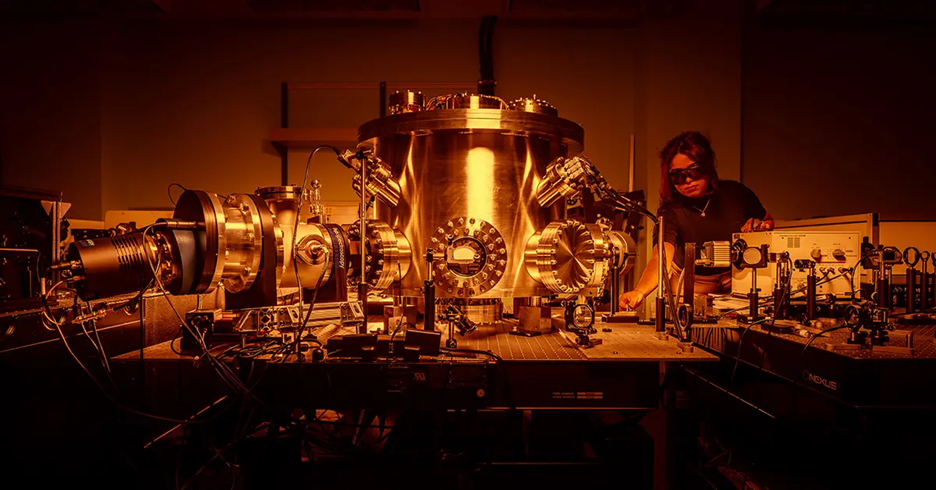
The Laser Ablation Plasma and Shocks (LAPS) Laboratory at UC San Diego is equipped with multiple nanosecond and femtosecond laser systems spanning a wide range of pulse durations and energies. These include: ELITE, with energy up to 30 J, variable pulse duration of 5–12 ns, and wavelengths of 1064 and 532 nm; ARCO, with energy up to 28 mJ, pulse duration of 30 fs, and wavelength of 800 nm; Continuum, with energy of 10 J, pulse duration of 10 ns with pulse shaping capability, and wavelength of 1064 nm; Quanta-Ray, with energy up to 1 J, pulse duration of 10 ns, and wavelengths of 1064 and 532 nm; and EKSPLA, with energy up to 100 mJ, pulse duration of 100 ps, and wavelength of 532 nm. Experimental studies of laser-material interaction and shock physics, as well as applications in extreme ultraviolet lithography and debris mitigation for high-repetition-rate future fusion devices, are conducted in a tabletop laboratory environment. Advanced diagnostics, including streaked optical pyrometry (SOP), photon Doppler velocimetry (PDV), extreme ultraviolet spectroscopy, and interferometry, are employed to characterize plasma and shock dynamics.
Driving plasmas to extreme magnetizations using strong laser compression and high initial magnetic field.
DOE/FES and DOE/NNSA National Laser Users Facility
Magnetized implosions can relax ignition requirements for inertial confinement fusion (ICF). The magnetic field compressed with the target acts in addition to inertia to confine the hot spot, resulting in a hotter fuel, allowing it to ignite at lower areal densities than otherwise possible and with slower implosions that are less susceptible to hydrodynamic instabilities. The physics of energy and magnetic flux transport is predicted by extended Magneto-Hydro-Dynamic (MHD) models, which suffer from a lack of experimental validation in the regime of high-energy-density plasmas (~1 g/cm3). In addition, the interpretation of measurements from complex magnetized hot dense plasmas requires novel and accurate modeling, such as detailed atomic and radiation transport physics for spectroscopy analysis.

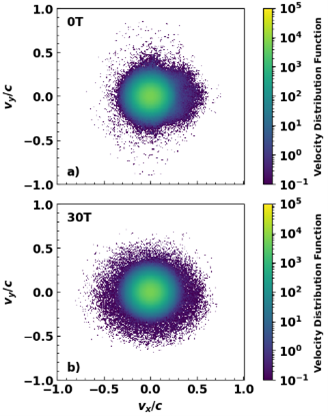
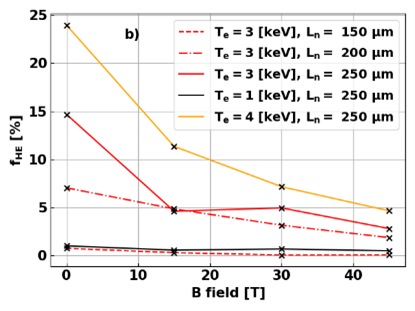
Our main goal is to develop a platform for the OMEGA-60 laser facility to study MHD effects in cylindrical implosions at regimes of large magnetic pressure and magnetization. 2-D simulations using the MHD codes GORGON and FLASH predict that a seed B-field of 30 T can be compressed to ~15-18 kT owing to flux compression when imploding the cylindrical target. As a result, the characteristic conditions of the compressed core are expected to be modified by the large magnetization and magnetic pressure thereby reached at maximum compression. On a few previous magnetized cylindrical compressions at the OMEGA-60 facility, the effect of the compressed B-field was investigated using neutron measurements only. However, the neutron yield in cylindrical implosions is rather low (on the order of 108-109) and e.g. a small target variation can induce very large yield fluctuations, therefore strongly limiting a clear interpretation of the results. Alternatively, we propose to use Ar/Kr dopant(s) in the D2 gas. As the core conditions are modified by the compressed magnetic field, we expect to observe systematic changes in the dopant emission spectra between unmagnetized and magnetized shots. Carrying out such magnetized implosion experiments will advance the modeling of B-field compression and diffusion, and the benchmarking of atomic kinetics and line shape calculations in magnetized plasmas relevant to complex ICF-related experiments with embedded B-fields. Simulations must include extended-MHD effects, which represent the transport of energy and magnetic flux in a plasma. Magnetized plasmas are thought to exhibit complex behavior in the electron population and, above resistive-MHD, extended-MHD additionally accounts for temperature gradient-driven transport—such as the Nernst term moving magnetic fields down electron temperature gradients—and electric-current-driven transport—such as the Hall term moving magnetic fields with the flow of charge. In this context, our goal is to obtain clear experimental data that will facilitate benchmarking of MHD codes and consequently help the modeling of magnetized HED experiments. In this context, we are recently developing an experimental campaign at OMEGA-60 to investigate the effects of extended-MHD effects such as Nernst on the imploded core by testing the de-magnetizing effects different Ar dopant concentrations can have on the imploded core due to an increased radiative cooling. Moreover, the interpretation of spectral emission measurements from complex magnetized experiments requires novel and accurate modeling of the detailed atomic and radiation transport physics. In this project, we are investing significant efforts to mature the spectroscopy diagnostic techniques for magnetized HED experiments. Finally, we carried out a satellite work on the effects of the magnetic field on the outer target's plasma corona, especially on the production of ICF-detrimental hot electrons from laser-plasma instabilities, using the Laser Plasma Simulation Environment (LPSE) hybrid simulation code. The results imply that, while hot electron production increases in a magnetic field, said population is confined away from the target surface, possibly reducing target preheat risks.
Efficient Ion acceleration by Continuous Fields
DOE/NNSA National Laser Users Facility
Ion beams driven by short-pulse high-intensity lasers have been an increasingly active area of research as the beams are appealing for their potential, broad range of applications. Extensive computational and experimental studies have discovered various laser-driven ion acceleration mechanisms. Most mechanisms require ideal conditions of ultra-high laser intensity and sub-micron target thickness, to acquire high ion energy, yet there still exists difficulty in producing the ideal conditions resulting in limitation of proton energy below 100 MeV so far.

In this project, we investigate promising concepts to enhance the peak cutoff energy and flux of short-pulse laser-accelerated ions via the synergetic effects of target transparency and continuous field acceleration. Recent studies using multi-picosecond pulses with modest laser intensities have shown promising results. Experimentally demonstrated proton energies of up to 30 MeV at quasi-relativistic intensities and 50 MeV with the double pulses are far beyond energies predicted by the well-established TNSA model scaling and experimental results for the same laser intensity with sub-ps pulses. The laser pulse interacting with an expanding under-dense plasma for multi-ps duration generates a 'super-ponderomotive' electron population and this is key to sustain electric fields for proton acceleration. This continuous ion acceleration can be further improved with the effect of target transparency by using multi-ps pulses and ultra-thin foils, suggesting a new approach to efficient ion acceleration.
Dynamics of high-energy proton beam focusing and transition into solid targets of different materials
DoE/NNSA National Laser Users Facility
Intense, focused proton beams have applications ranging from isochoric heating of plasma to imaging shock waves and magnetic fields. Beam production and use involve a constantly evolving target/plasma topology and hot electron flow as the protons are accelerated from a shaped surface into vacuum and then transition into target plasmas for heating or probing.

The dynamics involved become more complex as the laser energy and resulting beam current increase, and as beam pulse length increases. We have been awarded OMEGA EP laser time at the Laboratory for Laser Energetics to use high energy short pulse laser beams to extend previous proton focusing/transition studies to 10 ps pulse duration. We will be collecting detailed information about the forces that affect such beams, utilizing the second EP beam to produce protons to probe conditions set up by the first EP laser beam. Energy deposition and heating of a solid foil (dense plasma) by the focused proton beam will also be characterized by measuring its induced K-shell fluorescence emission via x-ray imaging and spectroscopy techniques. Our goal is to extend our understanding of the High-Energy Density physics involved facilitating optimal source designs for various medical and energy applications and eventually experiments like NIF integrated proton fast ignition experiments with the Advanced Radiographic Capability (ARC) beam.
Center for Fusion Energy -- Materials and Diagnostics for Extreme Conditions (MDeC)
UC National Laboratory Fees Research Program
The California Center for Fusion Energy -- Materials and Diagnostics for Extreme Conditions (MDeC) is a strategic partnership among four UC campuses (San Diego, Los Angeles, Irvine, and Santa Cruz) and two national laboratories (LLNL and LANL). This collaboration seeks to transform the scientific, technological, and educational foundations of fusion energy. Recent breakthroughs demonstrating ignition, burning plasma, and energy gain have fueled growing interest, along with over $10 billion in private investments. The Center enables transformative research, technical development, and training through DOE and UC facilities and unique research collaborations, which further positions UC as a leader in fusion energy.

Despite progress, significant engineering and design challenges remain before fusion energy can transition from experiments to commercially viable power plants. A coordinated effort between academia, national laboratories, and industry is essential. The Center has adopted a multidisciplinary approach to address grand challenges in the research areas of 1) materials under extreme conditions, 2) diagnostics under extreme radiation, and 3) the tritium fuel cycle. To tackle these challenges, this Center unites experts in state-of-the-art theory, material synthesis and fusion performance testing, and diagnostics spanning both magnetic and inertial fusion. It also leverages the advanced fusion research facilities and equipment managed by participating institutions to enable the development of cutting-edge fusion technologies.
The challenges in fusion energy transcend traditional disciplinary boundaries of physical sciences and engineering, requiring an integrated approach to education and training. The Center uses a multi-front approach offering a comprehensive series of courses on fusion energy, materials, diagnostics, radiation, tritium handling and fundamentals of fusion power plants. This program is a valuable resource for students and researchers across the University of California system and by providing access to these specialized courses, we aim to equip the next generation of fusion researchers and engineers with the knowledge and skills needed to drive innovation in this rapidly evolving field in collaboration with major fusion companies in the country.
Integrated Proton Fast Ignition Experiments at the OMEGA Laser Facility
DoE/NNSA National Laser Users Facility
Achieving ignition on the National Ignition Facility has generated significant interest in fusion energy and now the quest is raising net energy gain to the levels required for an economical, grid-scale inertial fusion energy power plant. Proton-driven Fast Ignition (PFI) is an alternative inertial confinement fusion scheme that promises higher gain and although researchers have previously evaluated different individual aspects of PFI, attention has now shifted towards integrated PFI experiments that include both the long pulse compression and short pulse ignition beams in order to better understand how compression impacts proton acceleration, transport, and heating.

Our team recently completed the first integrated PFI campaign at the OMEGA laser facility to measure the temperature increase in the compressed core due to heating by protons and visualize where the protons deposited their energy in the compressed plasma. In these experiments, an intense proton beam was generated from a curved hemispherical foil embedded within a cobalt-coated gold cone using the OMEGA EP short-pulse beam, which was then focused and guided into a copper-doped CH spherical capsule imploded by the OMEGA long-pulse beams.
We have also been awarded two more joint shot days in FY26/27 to conduct additional integrated PFI experiments on OMEGA. We plan to utilize an identical target configuration and still primarily rely on x-ray spectroscopy to diagnose proton heating in the compressed core, but with reduced OMEGA EP pulse duration to probe higher laser intensities compared to our previous experiments. Together, these investigations represent notable contributions to our knowledge of PFI, have established a framework for evaluating the robustness of the PFI concept, and have advanced the experimental study of warm dense matter.